Joint generation
Co-train future video and actions using a pretrained video backbone.
World action models Video ↔ Action
 1 Zhejiang University
 2 Institute of Artificial Intelligence (TeleAI), China Telecom
 3 National University of Defense Technology
 4 Institute of AI for Industries, Chinese Academy of Sciences
 5 Shenzhen University
Learning the correspondence between visual change and executable action.
Music: “Cylinder Five” by Chris Zabriskie · CC BY 4.0 · Credits & edits
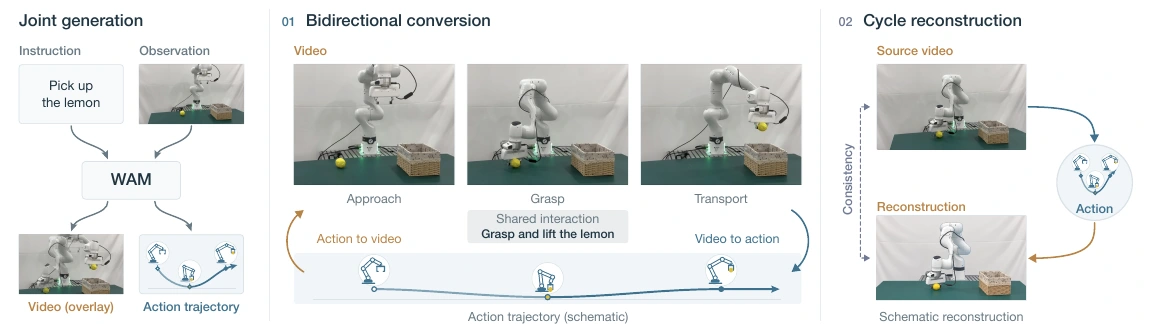
Actions change the world. Video reveals those changes. Cycle WAM learns the correspondence in both directions.
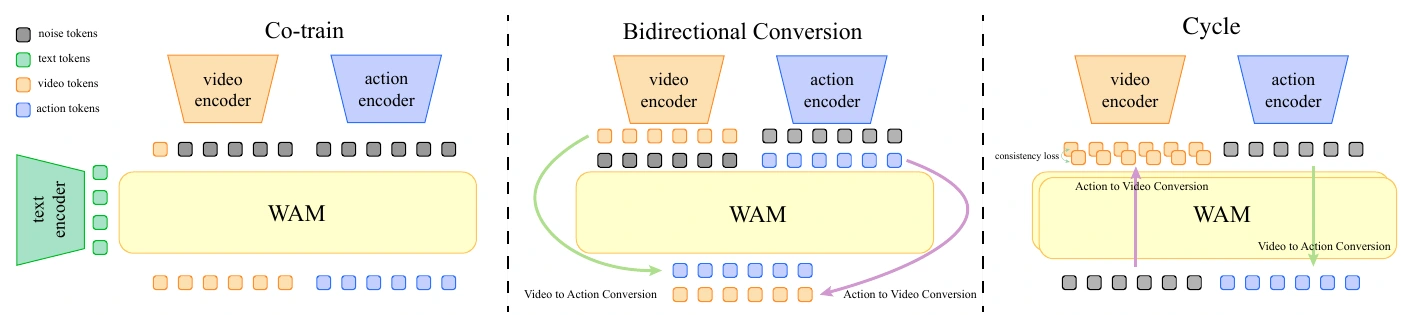
Building on a video-pretrained world action model, we augment joint video–action generation with bidirectional conversion to learn forward and inverse dynamics. A differentiable cycle-reconstruction objective then connects the two mappings: infer actions from video, and use those actions to reconstruct the video.
The resulting model supports action-conditioned visual prediction, action inference from video, and robot control within a shared framework.
Method
One shared WAM learns how an action looks,
and which actions explain a video.
Cycle consistency compares the reconstruction with the source
↗Co-train future video and actions using a pretrained video backbone.
Train video-to-action and action-to-video mappings with paired supervision.
Reconstruct the video through inferred actions, with gradients through both queries.
Real-robot demonstrations
Approach, grasp, transport, release.
Recorded tabletop manipulation.
Coordinated arm and gripper motion through grasping and placement.
The sequence shows transport and release above the basket; the landing is occluded.
Selected qualitative demonstrations. Across five evaluated real-world scenes, the paper reports task completion in 3/5 scenes for Cycle WAM and 0/5 for DreamZero. These counts do not establish repeated-trial reliability.
Forward dynamics
Recorded simulator interaction and model predictions.
LIBERO Spatial, task 0.
Left: recorded simulator interaction. Right: GT at the top, UWM at bottom left, Cycle WAM at bottom right.
Four matched segments · Two camera views per panel
Cycle WAM retains sharper visual boundaries in these examples. Object placement and view composition still differ from ground truth. Each panel contains two camera views; original frames are preserved without interpolation.
Evaluation
Reported values from the accompanying paper.
Read the PDF for protocols and full ablations.
17.8%
Spatial-T, Spatial-S, Goal-T, and Goal-S · 100 episodes per condition
| Method | Spatial-T | Spatial-S | Goal-T | Goal-S | Average |
|---|---|---|---|---|---|
| π0.5 | 1.0 | 20.0 | 2.0 | 38.0 | 15.3 |
| UWM † | 21.0 | 1.0 | 3.0 | 0.0 | 6.3 |
| DreamZero † | 27.0 | 13.0 | 12.0 | 2.0 | 13.5 |
| Cycle WAM | 24.0 | 25.0 | 19.0 | 3.0 | 17.8 |
Selected rows from Table I. † LIBERO-130-finetuned checkpoints evaluated alongside Cycle WAM. The average covers only these four conditions. Gains are not uniform across conditions or aggregate control settings.
59/60
98.3% overall · Three DreamZero-DROID 14B simulator scenes · 20 episodes each
| Variant | Scene 1 | Scene 2 | Scene 3 | Total |
|---|---|---|---|---|
| Official DreamZero | 20/20 | 17/20 | 15/20 | 52/60 |
| Cycle WAM w/o Cycle | 20/20 | 19/20 | 19/20 | 58/60 |
| Cycle WAM | 20/20 | 19/20 | 20/20 | 59/60 |
Table II. These are simulator results, separate from physical-robot experiments. Ablated runs are not paired by seed; incomplete training-budget records limit attribution of the additional Cycle gain.
0.63
Compared with 0.57 for UWM · Higher is better
| Model | MSE ↓ | MAE ↓ | PSNR ↑ | SSIM ↑ | Frame FID ↓ |
|---|---|---|---|---|---|
| UWM | 0.03 | 0.10 | 15.48 | 0.57 | 280.84 |
| Cycle WAM | 0.03 | 0.08 | 15.92 | 0.63 | 96.02 |
Table IV. Values are rounded to two decimals; unrounded MSE is 9.65% lower. These metrics do not measure temporal consistency or sensitivity to action interventions, or isolate Cycle’s contribution.
We thank Yifei Huang from Nanjing University for assistance with real-robot deployment.
Paper & citation
The PDF includes the method, theoretical analysis, evaluation protocols, and limitations.
Read the paperCode and model weights are coming soon.
@misc{yang2026cyclewam,
  title = {Cycle WAM: Coupling Action and
           Video through Cycle Consistency},
  author = {Qinglin Yang and Jiepeng Wang and
            Yuxing Huang and Haibin Huang and
            Kai Xu and Chi Zhang and
            Ruizhen Hu and Xuelong Li},
  year = {2026},
  eprint = {2611.04711},
  archivePrefix = {arXiv},
  primaryClass = {cs.CV},
  url = {https://arxiv.org/abs/2611.04711}
}
arXiv:2611.04711 · cs.CV